8 units (8 to 12 months)*
*Part-time students who are enrolled in less than 4 units per trimester are expected to take additional trimesters to complete.
February, June & October
ECU Sri Lanka Campus
LKR 103,000.00 per unit
2026 Domestic Unit Price (LKR)
USD 685.00 per unit
2026 International Unit Price (USD)
The ECC Diploma of Science Computing/IT program introduces you to the disciplines of computer science, software engineering, computer security, information technology and other emerging fields. All ECC modules are developed in consultation with the IT industry and have received the Australian Computer Society’s highest level of accreditation (Level 1). ECU will grant exemptions for the first year of study (120 credit points).
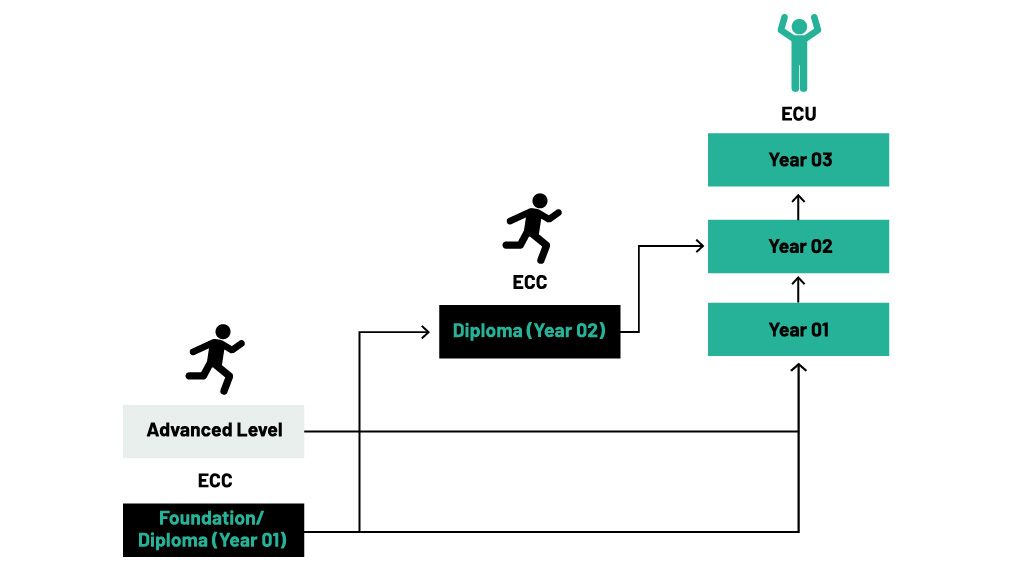
The Diploma of Science (Computing and IT) provides a pathway into ECU’s Computer Science and Cyber Security degrees, with first-year equivalence and direct progression into second year upon successful completion.
A minimum of 50% pass in all units is required for progression to ECU.
This unit develops a student’s understanding of systems analysis: definition of a system, the role of and context of systems analysis, interfacing with the user, the life cycle of a management information system from the feasibility study through to the post-implementation audit. Applying skills by fact-gathering, interviewing, presenting, group working, documenting an existing system; analysis techniques involving use cases, state diagrams, data modelling, data from diagrams, data dictionaries, decision tables, web page, screen and report design.
CSP1150D – Programming Principles
This unit introduces students to the principles of programming, including data manipulation, control structures, and abstraction. The unit focuses upon developing the ability to design and implement programs to solve problems.
MAT1252D – Mathematics for Computing
This unit presents fundamental topics in mathematics that are essential to computing studies, including propositional and predicate calculus, Boolean algebra, set theory, computer arithmetic and number systems in computing. It also introduces matrix algebra with applications to computing and cryptography.
SCI1125D – Professional Science Essentials
This unit will introduce students to the skills required of professional scientists, with a special focus on effective communication. These professional skills include techniques of accessing, evaluating and presenting scientific information. Written, visual and oral presentation skills for scientific and general audiences will be developed by analysing topical scientific issues. This unit will prepare students to develop careers in the science discipline of choice.
CSG1105D – Applied Communications
This unit introduces students to current and proposed telecommunications and networking infrastructures and their application in business and communications services. With a primary focus on the Internet and the World Wide Web, student examine in detail the principles, processes and technologies associated with data communications and computer networking, applications of the major carriage media, communications standards and emerging broadcast and narrowcast technologies based on communications channels.
CSG1207D – Systems and Database Design
This unit introduces students to the concepts of relational databases, including database design via normalisation and entity-relationship modelling to solve problems. It explores the use of Structured Query Language (SQL) to create, populate and administer relational databases and to perform complex queries upon the data inside them.
The unit introduces computer security which serves as a preliminary unit to prepare students for various advanced studies within their respective courses. The unit focuses on understanding the potential threats and vulnerabilities geared towards a variety of computer-related assets and examines a wide range of countermeasures to overcome weaknesses and minimise threats.
ENS1161D – Computer Fundamentals
This unit introduces the fundamental architecture and operating principles of the digital computer system. Students will learn how modern computers are organised and operated, how they can be programmed at an assembly (machine) language level, and how they use higher-level languages and the role of operating systems. Students will also learn fundamental concepts related to interfacing peripheral components to computer systems, including memory and secondary storage, and explore different computer systems, including an overview of virtualisation and cloud technologies.
Students can also enter into many universities in Australia or Navitas-partnered Universities for the 2nd year in IT related majors such as Networking, Computer Security, Information Systems, Internet Computing, and Graphic Design etc
Completion of the University Foundation Program and the ECC Diploma Year 01 program can lead into the first year undergraduate degrees at ECU.