Year 1: 8 units (8 to 12 months)*
Year 2: 8 units (8 to 12 months)*
*Part-time students who are enrolled in less than 4 units per trimester are expected to take additional trimesters to complete.
Year 1: February, June, October
Year 2: February, June, October
ECU Sri Lanka Campus
Year 1: 74,000.00 per unit
Year 2: 112,450.00 per unit
2026 Domestic Unit Price (LKR)
Year 1: 495.00 per unit
Year 2: 725.00 per unit
2026 International Unit Price (USD)
Diploma of Science (Engineering Studies) (Year 1) is designed to enhance your learning experience, and provide you with the underpinning knowledge necessary to prepare you for studies in Engineering related courses at university level.
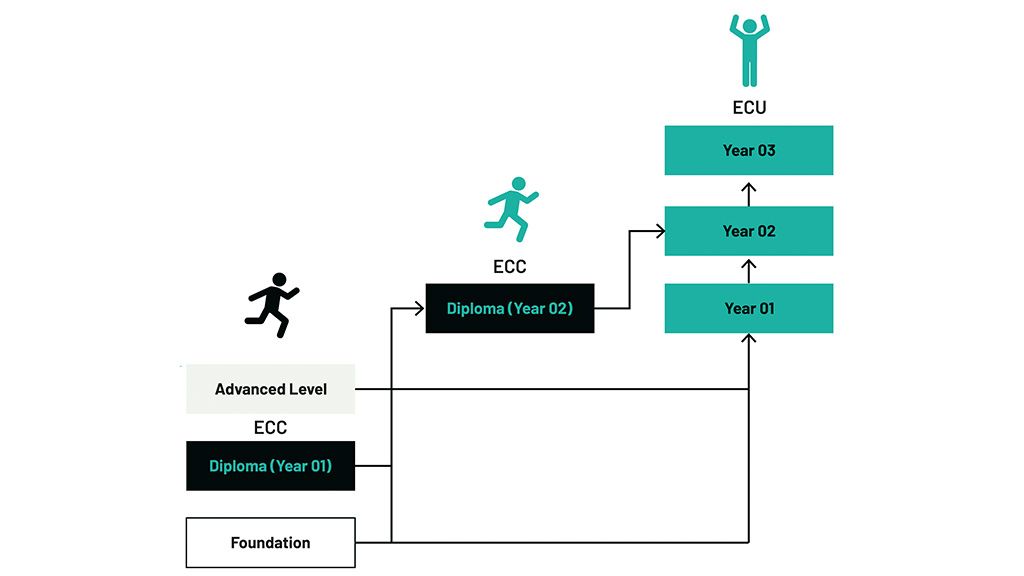
Diploma of Science (Engineering Studies) (Year 2) is specially designed for students wishing to enrol in the wide range of courses offered by ECU’s School of Engineering. ECU Engineering courses are structured heavily around practical learning; you will have the opportunity to work with real hardware, not just simulation packages. Teaching facilities include advanced laboratories with modern industry-standard equipment. Students who complete the Diploma of Science (Engineering Studies) (Year 2) at ECC will receive up to 8 units (120 credit points) advanced standing, the equivalent of the first year, in the respective bachelor’s degree at ECU.
A minimum of 50% pass in all units is required for progression to ECU.
This unit introduces the foundations of academic writing – from library research using databases, selection of approved academic resources, to writing paragraphs and essays, using the APA referencing system and delivering oral presentations using multi-media. The unit also includes essential study skills to assist with time management, note-taking and the use of memory aids for study purposes.
Pre-Requisite Units: None
Tuition Pattern: Weekly 4hr Class
Credits: 15
CPT107 - Introductory Computing
This unit develops knowledge and skills in computing systems – software, hardware, digital security, communication networks, internet, information and data management. Students will develop their digital literacy and gain practical skills in specific computing applications from the Microsoft Office Suite. Students will also be introduced to some basic hands-on skills in program design using Pseudocode.
Pre-Requisite Units: None
Tuition Pattern: Weekly 4hr Class
Credits: 15
CHE100 – Introductory Chemistry
This Chemistry unit is designed for students who wish to study engineering, physical sciences or health sciences at a tertiary level. It covers the study of matter and its interactions (chemical quantities, atoms, states, chemical bonding, chemical calculations, electronic and molecular structures, organic and inorganic chemistry). Students will develop skills in organising, analysing and interpreting information and use simulated activities to prepare for future laboratory work.
Pre-Requisite Units: None
Tuition Pattern: Weekly 4hr Class
Credits: 15
MTH104 - Introductory Mathematics
This unit is designed for students who require a general mathematics background suitable for studies in business, health sciences and computing/IT courses. Students will learn to use a scientific calculator and develop critical thinking skills to identify, analyse, synthesize and solve mathematical calculations in arithmetic, statistics, algebra, functions and their graphs, optimisation, sequences, series, growth and decay, trigonometry, geometric sequences, series, set theory and interest.
Pre-Requisite Units: None
Tuition Pattern: Weekly 4hr Class
Credits: 15
ELE100 - English Language Enhancement
This English language unit aims to enable you to improve your ability to communicate in English to participate effectively in academic and professional environments. A balance of receptive (reading, listening) and productive (speaking, writing) skills are developed through communicative classes and self-study. The unit will also provide language awareness tools to enable self-directed and ongoing learning.
Pre-Requisite Units: None
Tuition Pattern: Weekly 4hr Class
Credits: 15
COM220 - Workplace Communication - Employability
Students will identify, analyse and apply communication, social and intercultural skills for effective interpersonal and workplace relationships. This unit develops written skills, oral presentation skills and research skills, to prepare students for academic or professional environments. Students will make connections between learning and future employability through topics such as effective workplace relationships, negotiation, managing conflict, and skills for teamwork and leadership.
Pre-Requisite Units: None
Tuition Pattern: Weekly 4hr Class
Credits: 15
This unit is designed to provide students with knowledge in a broad range of physics concepts and help students identify physics and technology’s impact on society. It is designed for those who do not have a physics background at the secondary level but wish to study engineering or physical sciences at the university. This unit covers theory and practical investigations, using logical and analytical thinking, and developing skills in communicating scientific information. Physics principles and methods applicable to Newton’s Laws, forces, heat, motion, electricity, wave motion and optics are included.
Pre-Requisite Units: None
Tuition Pattern: Weekly 4hr Class
Credits: 15
MAT137 – Introductory Applied Maths
This unit introduces students to functions, calculus, descriptive statistics, probability and random variables, and their application to solve applied problems. Students will be introduced to functions and their properties, differential and integral calculus and its application to optimisation, area and rectilinear motion problems, arithmetic and geometric and sequences, sets and probability, descriptive statistics and discrete and continuous random variables.
Pre-Requisite Units: None
Tuition Pattern: Weekly 4hr Class
Credits: 15
ENM1102D – Engineering Drawing and Computer-Aided Design (CAD)
This unit introduces students to technical drawing and the use of computer-aided design tools. Students will progress from hand drawings which meet relevant Australian standards to the use of computer-aided design tools for engineering drawings.
Pre-Requisite Units: None
Tuition Pattern: Weekly 4hr Class
Credits: 15
ENS1154D – Introduction to Engineering
This unit introduces students to the discipline and practice of professional engineering. The role of engineers and some of the important concepts that characterise the engineering approach to solving technical problems are described. In addition, the importance of appropriate communication and the management aspects of engineering are introduced. The unit includes a group design project that takes the student through the engineering design process from client specification, around an iterative design loop, to a fully documented final solution.
Pre-Requisite Units: None
Tuition Pattern: Weekly 4hr
Credits: 15
ENS1180D – Introduction to Energy and Resource Engineering
This unit provides an introduction to the concepts of energy and resources, including resource estimation and extraction, and the conversion and use of energy resources for supporting domestic, commercial and industrial needs. The units covers principles of sustainable energy and resource use, energy sources, resource extraction and energy conversion, transmission and utilisation; and the associated economic costs and benefits, and environmental impacts. The design of simple energy systems is introduced together with their all-of-life costs and benefits using computer-based modelling tools.
Pre-Requisite Units: None
Tuition Pattern: Weekly 4hr Class
Credits: 15
This unit deals with complex numbers, functions of two variables and their derivatives, differentiation of hyperbolic, inverse trigonometric and reciprocal trigonometric functions, related rates problems, integration techniques and their application to solve volume and length problems, the solution of first and second order differential equations and their application to applied problems.
Pre-Requisite Units: GCE A/L Combine Maths, MAT137, FAM510 or equivalent
Tuition Pattern: Weekly 4hr Class
Credits: 15
ENS1101D – Engineering Mechanics
This unit covers principles of engineering mechanics with a focus primarily on statics and application of these principles to problems related to engineering structures and systems. Students draw free-body diagrams to describe structural elements/systems; and use principles of statics to resolve forces and movements in engineering systems.
Pre-Requisite Units: GCE A/L Combine Maths, MAT137, FAM510 or equivalent. GCE A/L Physics, PHT100, FPH400 or equivalent.
Tuition Pattern: Weekly 4hr Class
Credits: 15
ENS1115D – Materials and Manufacturing
This unit develops students’ knowledge of common engineering materials and enables them to select materials based on their inherent properties and to develop a direct link between the structure and mechanical behaviour of materials.
Pre-Requisite Units: None
Tuition Pattern: Weekly 4hr Class
Credits: 15
ENS1253D1 – Electrical Engineering Fundamentals
This unit introduces a range of concepts that are fundamental to the fields of electrical and electronic engineering. Students will develop their conceptual and analytical understanding of electrical circuits and systems through lectures, tutorials and laboratory work.
Pre-Requisite Units: None
Tuition Pattern: Weekly 4hr Class
Credits: 15
This unit introduces linear algebra, operations research, probability, and their application to problems arising in applied contexts. Students will be introduced to the vectors, matrices, the solution of linear systems of equations, the formulation and solution of linear programming problems, network optimisation, continuous probability distributions and reliability analysis.
Pre-Requisite Units: GCE A/L Combine Maths, MAT137, FAM510 or equivalent
Tuition Pattern: Weekly 4hr Class
Credits: 15
Students can also enter into many universities in Australia or Navitas-partnered Universities for the 2nd year in Engineering related majors such as Chemical, Civil, Computer Systems, Electrical Power, Electrical and Renewable Energy, Electronics and Communications, Instrumentation Control and Automation, Mechanical etc.
Completion of the University Foundation Program and the ECC Diploma Year 01 program can lead into the first year undergraduate degrees at ECU.