8 units (8 to 12 months)*
*Part-time students who are enrolled in less than 4 units per trimester are expected to take additional trimesters to complete.
February, June & October
ECU Sri Lanka Campus
LKR 112,450.00 per unit
2026 Domestic Unit Price (LKR)
USD 725.00 per unit
2026 International Unit Price (USD)
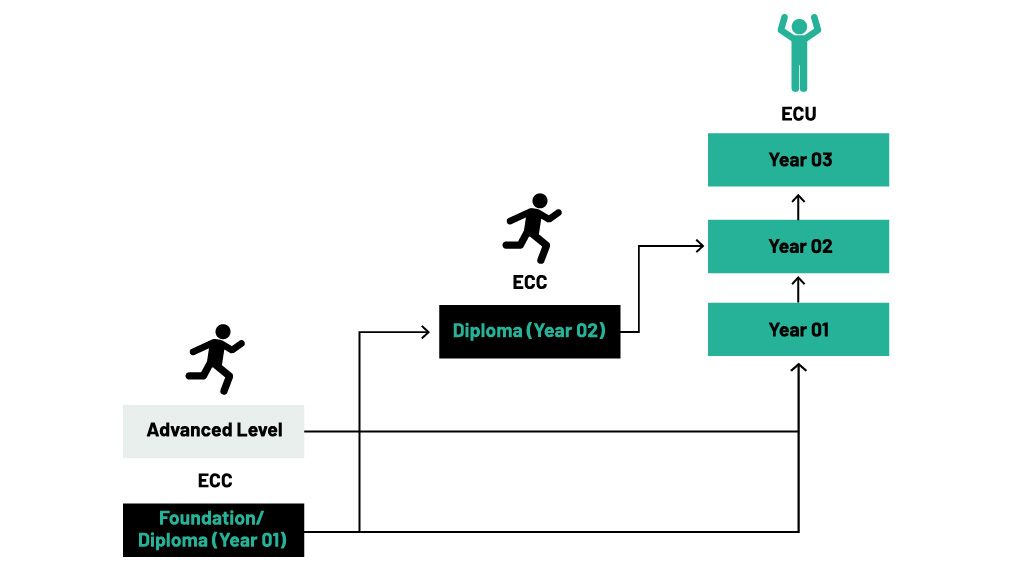
The Diploma of Science (Engineering Studies) program, is specially designed for students wishing to enroll in a wide range of programs offered by ECU’s School of Engineering. ECU Engineering programs are structured heavily around practical learning and you will have the opportunity to work with modern equipment, with teaching facilities including advanced laboratories. ECU will grant exemptions for the first year of study (120 credit points).
The Diploma of Science (Engineering Studies) is a hands-on pathway into ECU’s engineering degrees, offering first-year equivalence and direct progression into second year upon successful completion.
A minimum of 50% pass in all units is required for progression to ECU.Core Units
ENM1102D – Engineering Drawing and Computer-Aided Design (CAD)
This unit introduces students to technical drawing and computer-aided design tools. Students will progress from hand drawings that meet relevant Australian standards to computer-aided design tools for engineering drawings.
ENS1154D – Introduction to Engineering
This unit introduces students to the discipline and practice of professional engineering. The role of engineers and some of the important concepts that characterise the engineering approach to solving technical problems are described. In addition, the importance of appropriate communication and the management aspects of engineering are introduced. The unit includes a group design project that takes the student through the engineering design process from client specification, around an iterative design loop, to a fully documented final solution.
ENS1180D – Introduction to Energy and Resource Engineering
This unit introduces the concepts of energy and resources, including resource estimation and extraction and the conversion and use of energy resources for supporting domestic, commercial and industrial needs. The units cover principles of sustainable energy and resource use, energy sources, resource extraction and energy conversion, transmission and utilization, and the associated economic costs and benefits, and environmental impacts. The design of simple energy systems is introduced together with their all-of-life costs and benefits using computer-based modelling tools.
This unit deals with complex numbers, functions of two variables and their derivatives, differentiation of hyperbolic, inverse trigonometric and reciprocal trigonometric functions, related rates problems, integration techniques and their application to solve volume and length problems, the solution of first and second-order differential equations and their application to applied problems.
ENS1101D – Engineering Mechanics
This unit covers principles of engineering mechanics, focusing primarily on statics and applying these principles to problems related to engineering structures and systems. Students draw free-body diagrams to describe structural elements/systems and use principles of statics to resolve forces and movements in engineering systems.
ENS1115D – Materials and Manufacturing
This unit develops students’ knowledge of common engineering materials and enables them to select materials based on their inherent properties and to develop a direct link between the structure and mechanical behaviour of materials.
ENS1253D1 – Electrical Engineering Fundamentals
This unit introduces a range of concepts that are fundamental to electrical and electronic engineering. Students will develop their conceptual and analytical understanding of electrical circuits and systems through lectures, tutorials, and laboratory work.
This unit introduces linear algebra, operations research, probability, and their application to problems arising in applied contexts. Students will be introduced to the vectors, matrices, the solution of linear systems of equations, the formulation and solution of linear programming problems, network optimisation, continuous probability distributions and reliability analysis.
Students can also enter into many universities in Australia or Navitas-partnered Universities for the 2nd year in Engineering related majors such as Chemical, Civil, Computer Systems, Electrical Power, Electrical and Renewable Energy, Electronics and Communications, Instrumentation Control and Automation, Mechanical etc.
Completion of the University Foundation Program and the ECC Diploma Year 01 program can lead into the first year undergraduate degrees at ECU.