8 units (8 to 12 months)*
*Part-time students who are enrolled in less than 4 units per trimester are expected to take additional trimesters to complete.
February, June & October
ECU Sri Lanka Campus
LKR 112,450.00 per unit
2026 Domestic Unit Price (LKR)
USD 725.00 per unit
2026 International Unit Price (USD)
The ECC Diploma of Health Science program, introduces you to the biological, social and cultural elements involved in healthcare and provides foundation concepts to progress in your chosen program. After completing the ECC diploma, students can enter a Bachelor of Science (Biomedical Science) degree in ECU Sri Lanka. ECU will grant exemptions for the first year of study (120 credit points).
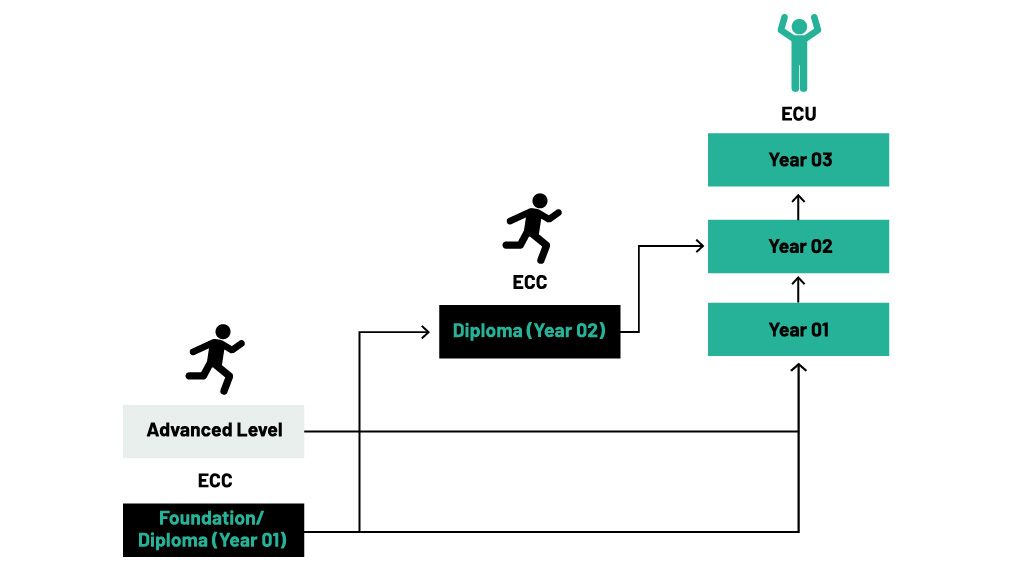
Our on-campus pathway Diplomas provide a direct route into Edith Cowan University, with programs equivalent to first year university and guaranteed progression into second year upon successful completion.
A minimum of 50% pass in all units is required for progression to ECU.
MAT1114D – Introductory Statistics
This unit deals with the methods and skills of organising, summarising and presenting numerical data. The concepts of estimation and hypothesis testing are studied, with the emphasis on analysing real data.
MHS1101D – Anatomy and Physiology - 1
This unit provides a comprehensive introduction to foundational concepts in human anatomy and physiology. The unit investigates core concepts in the cellular, chemical and biochemical structure and functions of the body. It then examines the developmental, anatomical and physiological features of the nervous and musculoskeletal systems.
This unit provides students with information about genetic issues they could encounter during their lives. It begins with classical genetics – cell division, transmission of traits, cytogenetics and developmental genetics. Emphasis then shifts to DNA structure, gene expression, and recombinant DNA technology before the genetic nature of cancer is introduced. The unit concludes with an analysis of the social, legal and ethical issues arising from genetic testing and screening, genetic counseling, reproductive technology, gene therapy, genetic treatment and the role of biotechnology in society.
SCC1123D – Chemistry for the Life Sciences
This broadly based unit will introduce the student to important chemical concepts and principles. The unit will provide the essential chemistry background required for courses in the biological, environmental and health sciences.
SCH1104D - Introduction to Pathophysiology
This unit examines the concepts of health and disease in human populations and the principles and mechanisms of the disease processes. The various components and interactions of the body’s defence system and the relationship of environmental factors to the disease process are considered. The morphology, pathogenesis and clinical course of diseases are considered in detail.
MHS1102D – Anatomy and Physiology - 2
This unit examines the anatomy and physiology of the major organ systems within the body. The systems will be investigated with respect to their individual structure and function and their roles as part of an integrated whole.
SCC1226D – Introduction to Organic Chemistry and Biochemistry
This unit provides an introduction to organic chemistry and biochemistry. It covers the structure and reactions of important classes of organic compounds and biomolecules, including carbohydrates, lipids, proteins, enzymes, and nucleic acids. Various important applications will be described, including polymers, medicinals, soaps, detergents.
This unit develops cross-cultural understanding by addressing cultural issues, emphasising health and culture in patient management.
Students can also enter into many universities in Australia or Navitas-partnered Universities for the 2nd year in health related majors such as Biomedical, Sports Science, Psychology, Nutrition Bioscience etc.
Completion of the University Foundation Program and the ECC Diploma Year 01 program can lead into the first year undergraduate degrees at ECU.